

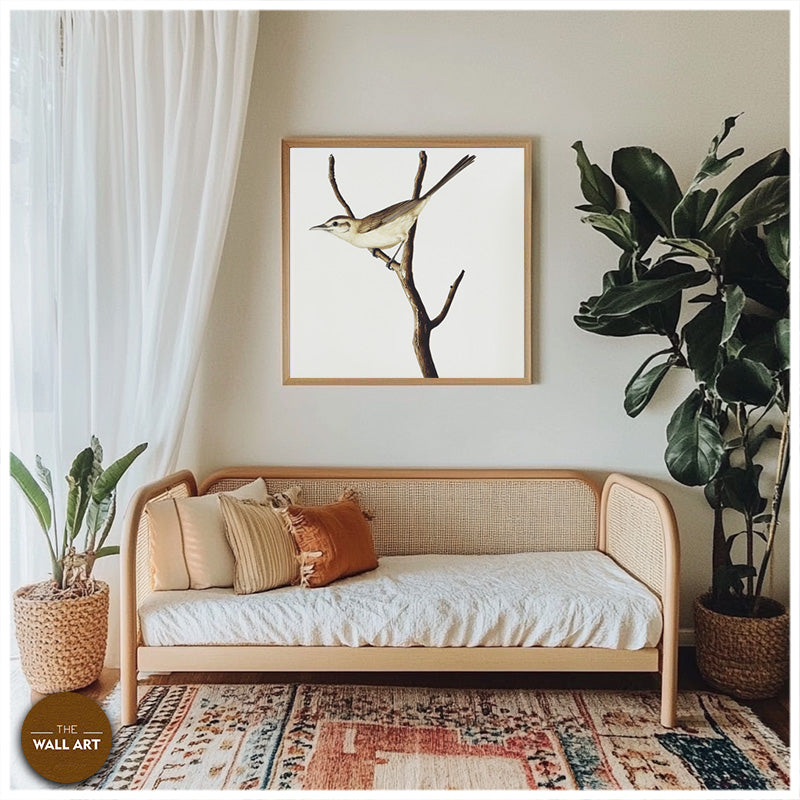
Japandi wall art works when it does less. Look for one clear subject, generous white or plain space around it, and colours borrowed from nature – timber, stone, clay, leaf green and the odd soft accent. The Japandi style blends Japanese restraint with Scandinavian comfort, so the art should feel calm enough to live with every day.
What makes wall art Japandi?
- A single focus: one bird, one tree, one small group – not a busy scene.
- Negative space: blank areas give the eye somewhere to rest.
- Natural palette: warm whites, browns, greys and muted greens, with colour used sparingly.
- Natural frames: light timber or oak frames echo Japandi furniture.
Start with the Japandi collection, then branch out to Neutral prints that share the same quiet feel.
The bird on a branch: Japandi at its simplest
Borwn Bird on Branch is about as Japandi as a print gets: a small brown bird perched on a bare, angular branch against a wide expanse of off-white. Nothing else competes for attention. In a natural timber frame above a rattan daybed, it looks right at home with linen cushions and a fiddle-leaf fig. If you only buy one piece for a Japandi room, start here.

Movement without clutter
Simple does not have to mean static. Flock of Fish III shows a small school of fish swimming across a white background in inky blue, black and touches of orange. The loose, brushy style recalls Japanese ink work. Above a bed with crumpled grey linen and timber bedside tables, the hint of orange picks up a mustard cushion and keeps the room from feeling cold.

Native plants, Japandi style
Japandi translates beautifully to Australian homes when the subject is local. Australian Black Boy Tree is a study of a single grass tree – a soft olive-green crown on a pale trunk against a warm cream background. In a living room with a low stone-coloured sofa, concrete-look walls and a wall of glass onto the garden, it brings the outdoors in without adding busy colour.

Earthy tones and human warmth
Pure minimalism can feel cool, so add warmth through colour. Hands shows several hands reaching towards each other in terracotta, ochre, sage and dark brown on a blush background. It is still simple – just one idea – but its earthy palette sits well against timber cladding and a low platform bed. This is a good pick for a bedroom or a reading corner that needs some heart.

A touch of Japanese tradition
Peacock in Flower Blossom nods to classic Japanese bird-and-flower art: a deep blue peacock perched among pale pink blossom on a soft white background. The colour is confined to the bird, so the print still feels light. In a pale room with a timber cot or bed and a woven pendant, it adds a gentle focal point – lovely for a nursery or guest room.

Softer, desert-inspired neutrals
If you like Japandi but want a little more colour, look at sun-washed landscapes. Spring on Desert IV shows desert plants and a small adobe-style building in cream, sage, sand and flecks of yellow. Above a rattan daybed with rust cushions and a patterned rug, it bridges Japandi and relaxed boho styling.

How to hang Japandi wall art
- Less, but larger: one well-sized piece beats a cluster of small ones. Above a bed or sofa, aim for about two-thirds of its width.
- Leave space around it: do not crowd the print with shelves, clocks and mirrors.
- Keep frames consistent: natural wood or oak frames throughout the house create calm. Our standard canvas frames come in natural wood, and poster frames in natural oak.
- Low and grounded: Japandi furniture sits low, so hang art a little lower than usual – around 20 cm above a low bed or sofa.
Check the Size guide to compare sizes, and browse Earthy prints for more warm, natural colour.
FAQ
What colours are used in Japandi wall art?
Warm whites, beige, timber browns, charcoal and muted greens are the base. Small accents of indigo, terracotta or soft pink work if used sparingly.
Can I use colourful art in a Japandi room?
Yes, if the colour sits within plenty of plain space and repeats something already in the room, such as a cushion or ceramic.
Which frame colour suits Japandi?
Natural wood or oak frames are the most Japandi choice. Black frames also work in darker, more Japanese-leaning rooms.


